
THE STUPLIME
A Befuddling Mix Of Logic Nonsense
SUBLIME
STUPIDIFICATION
CONTRADICTION
ANTAGONISM
DISJUNCTION
The web is what Stanford professor Sianne Ngai calls stuplime, a combination of the stupid and the sublime. […] It’s this tension that keeps us glued to the web. […] Were it entirely stupid or were it entirely sublime, we would’ve gotten bored long ago. A befuddling mix of logic and nonsense, the web by its nature is surrealist: a shattered, contradictory, and fragmented medium.
Kenneth Goldsmith, Wasting Time on the Internet, 2016
The Stuplime: A Befuddling Mix of Logic and Non-Sense consists of a digital artifact that, in three distinct instances, addresses the Stuplime. This concept, coined by cultural critic Sianne Ngai, characterizes the contemporary Internet experience as a combination of the notions stupid and sublime. Based on the exploration of the contrast between content and delivery mechanism, this artifact explores emphatic strings of this term, informed by the etymology of the word stupid, whose root is linked to stupefy, as a word close to the sublime. Watching a reading of a lesser affection and an overwhelmingly greater one, we are placed in a context that initially appears alienating, but which then proves disconcerting enough for us to continue exploring it.
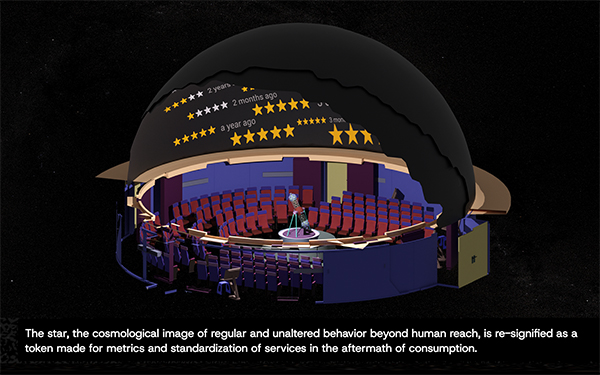
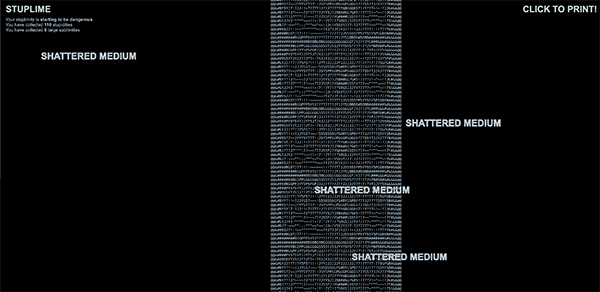
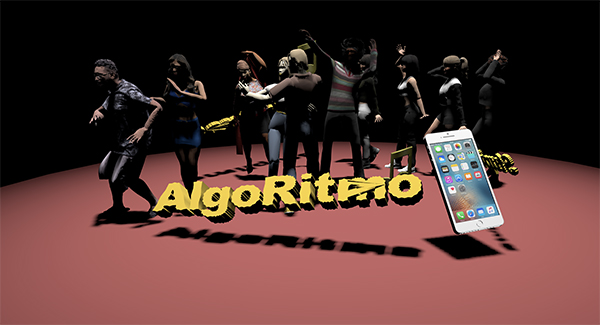
The first version of this artifact is Kant's house, which shows the infinite ASCII translation of an engraving of Immanuel Kant's house in Könisgberg. AlgoRhythm, on the other hand, looks at the performative space of dance in a post-digital and post-internet context, pointing out a categorical redundancy. Cosmos vs. Cosmetics, on the other hand, presents a sectioned planetarium in which stars from online reviews of real places are projected onto a dome, and the star position of these classified places is returned to us in real time. This instance is also supported by Beatriz Colomina and Mark Wigley's characterization of a “transparent human, fully articulate in his likes and dislikes” as “a market-driven concept of an ideal consumer constantly offering feedback to reduce any friction in the production, distribution and consumption of artefacts.”
The web is what Stanford professor Sianne Ngai calls stuplime, a combination of the stupid and the sublime. […] It's this tension that keeps us glued to the web. […] Were it entirely stupid or were it entirely sublime, we would've gotten bored long ago. A befuddling mix of logic and nonsense, the web by its nature is surrealist: a shattered, contradictory, and fragmented medium.
Kenneth Goldsmith, Wasting Time on the Internet, 2016
SUBLIME
STUPIDIFICATION
CONTRADICTION
ANTAGONISM
DISJUNCTION
The Stuplime: A Befuddling Mix of Logic and Non-Sense consists of a digital artifact that, in three distinct instances, addresses the Stuplime. This concept, coined by cultural critic Sianne Ngai, characterizes the contemporary Internet experience as a combination of the notions stupid and sublime. Based on the exploration of the contrast between content and delivery mechanism, this artifact explores emphatic strings of this term, informed by the etymology of the word stupid, whose root is linked to stupefy, as a word close to the sublime. Watching a reading of a lesser affection and an overwhelmingly greater one, we are placed in a context that initially appears alienating, but which then proves disconcerting enough for us to continue exploring it.
The first version of this artifact is Kant's house, which shows the infinite ASCII translation of an engraving of Immanuel Kant's house in Könisgberg. AlgoRhythm, on the other hand, looks at the performative space of dance in a post-digital and post-internet context, pointing out a categorical redundancy. Cosmos vs. Cosmetics, on the other hand, presents a sectioned planetarium in which stars from online reviews of real places are projected onto a dome, and the star position of these classified places is returned to us in real time. This instance is also supported by Beatriz Colomina and Mark Wigley's characterization of a “transparent human, fully articulate in his likes and dislikes” as “a market-driven concept of an ideal consumer constantly offering feedback to reduce any friction in the production, distribution and consumption of artefacts.”
Francisco Menezes